Dark web
Cyberboswachters
This course was created with the help of AI assistance. Some images are AI-generated.
The internet is an iceberg
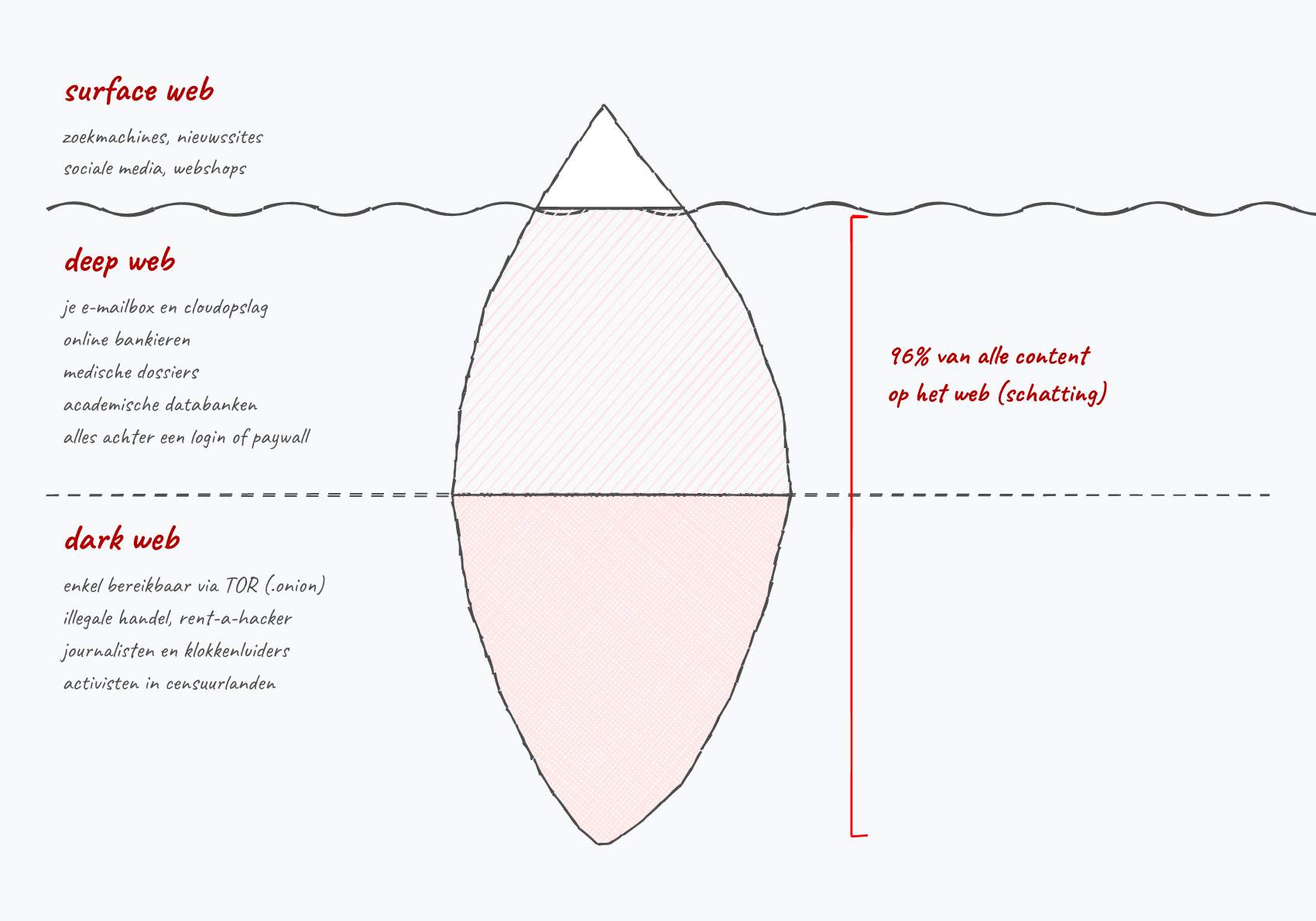
The internet iceberg: surface web, deep web and dark web.
The three layers
| Layer | Description | Access |
|---|---|---|
| Surface Web | Everything Google indexes | Regular browser |
| Deep Web | Databases, gated sites, private accounts | Login required |
| Dark Web | Anonymous, encrypted, not indexed | Special software (TOR) |
Note
The Deep Web is much larger than the Surface Web - think of all the corporate databases, medical records, cloud storage, … that are never indexed by Google.
The Dark Web is a small but notorious part of the Deep Web.
The internet is not really anonymous
On the regular internet you are almost always traceable:
- via IP address, cookies, provider logs, trackers, …
- some countries go much further: full control or blacklisting of sites
- China, Saudi Arabia, Iran, Egypt, North Korea, Cuba, …
Note
Being able to express your opinion under a pseudonym (nom-de-plume) is important for a democracy. Not everyone (and certainly not the government) needs to know what you legally do in your free time.
Privacy vs investigation remains a difficult balance.
Characteristics of the Dark Web
Anonymous
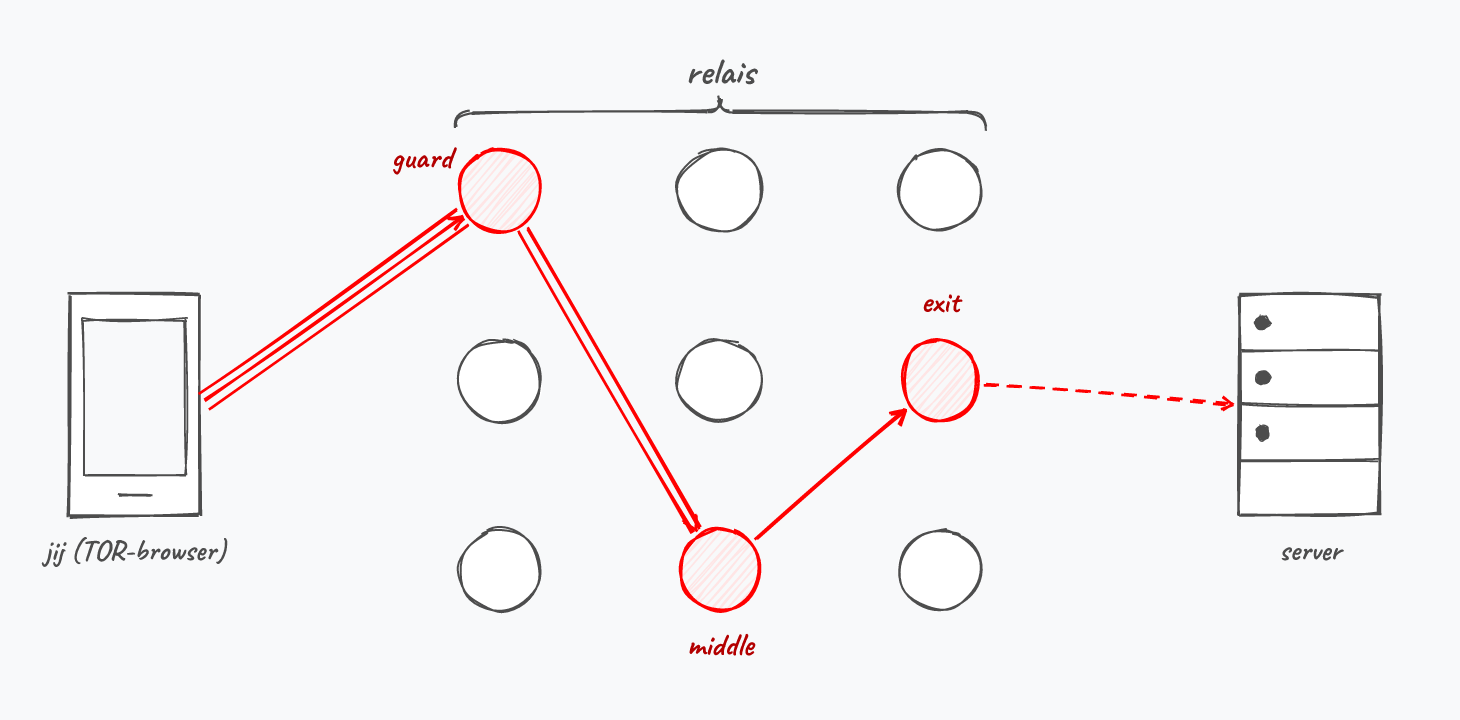
Connections are routed through several intermediate servers → it is virtually impossible to trace who visits what.
Encrypted
All communication is strongly encrypted → third parties cannot eavesdrop.
Decentralised
No central authority → hard to censor or take down.
Good and bad use
Legitimate use
- Journalists communicating safely from dictatorships
- Whistleblowers (e.g. WikiLeaks sources)
- Activists in countries with censorship (China, Iran, North Korea)
- Anonymous freedom of expression
Criminal use
- Trade in drugs, weapons and stolen data
- Sale of credit card details
- “Rent-a-hacker” services
- Ransomware-as-a-Service platforms
- Child abuse material
Important
The Dark Web is not illegal by definition - but what you do on it can be.
Anonymity ≠ free pass: law enforcement also tracks activity on the Dark Web. Illegal activities remain criminally prosecutable.
In countries such as Russia and China the use of the Dark Web itself is already a crime.
Access via TOR
TOR = The Onion Router
- Your traffic is routed through multiple relay servers worldwide
- Each server only knows the previous and next hop → no single server knows the full path
- Dark web sites are recognisable by their
.onionaddress- Only reachable through the TOR browser
TOR: drawbacks
| Drawback | Explanation |
|---|---|
| Slow | Traffic passes several servers worldwide |
| Blocked | Some sites refuse TOR traffic |
| Firewalls | Corporate networks block TOR by default |
Tip
Browsers such as Brave already integrate TOR - one click to surf anonymously.
TOR also offers extra privacy on the regular internet, not just on the Dark Web.
Why should you know this?
As a cyber ranger you will inevitably encounter the Dark Web:
- Stolen data (passwords, credit cards, corporate secrets) is traded there
- Criminal tools and exploits are for sale or rent
- Threat intelligence: security teams monitor the Dark Web for early warnings
- Understanding privacy technologies like TOR helps with both defence and investigation
Warning
Never visit the Dark Web from a work device or corporate network.
Even passive browsing can expose you to illegal content or compromised servers.
Explore for yourself
Before you set off - check whether your IP is effectively protected:
A good starting point on the Dark Web itself:
- The Hidden Wiki → thehidden-wiki.org
- collection of introduction points, search engines and interesting onions
- Extra list of onions: k00.fr/l1octcbo
Warning
Go exploring, but don’t click blindly through - many sites are shady, illegal or compromised.
